Maya Man and Luke Shannon Make :* *: Out at NODE
The 5:4 aspect ratio is often associated with older LCD monitors from the 2000s, before everything became 19.5:0 (iPhones & Samsung Galaxy), 16:10 (MacBooks), or 1.43:1 (IMAX 70mm). And I realized how much I missed that aspect ratio when I first walked into the show.
At NODE, a constellation of Maya's Seven Websites rotates through LED screens at 1:1, 4:5, 5:4, and 32:9, arranged to layer and shift with different viewing angles--imagine physically diving into one of your browser windows, especially if you're a tab hoarder like me.
"They're doing things with software that could not be done in any other media, and they're utilizing its ability to change as a way to choreograph time." - Read it and Weep, 2022
Words and sentences are shuffled, rearranged, and combined into sentences as nonsensical as they are familiar, drawn from sources such as song lyrics, YouTube videos, Instagram captions, online platforms like Depop, and the artist's own journal. Each of the websites is its own time capsule of an internet trend (silent manifestation videos in shift reality instantly ~ {very powerful}, 2022), a shared online experience ((The Angels Wanna Wear My) Red Shoes, 2025), to the examination of a consistent public presence on the internet (Dress Code, 2023; Trust Exercise, 2023).
Each of Maya’s seven websites is generative, and the words are often written, overwritten, and densely packed and layered to the point of redaction. Watching the texts stack atop each other before I’ve had a chance to read it all reminds me of a time when watching something, anything on Bilibili was THE after-school activity for me. It’s a Southeast/East Asian website that lets viewers post comments and text that sync to the video's timecode and appear as an overlay atop the content. Viral moments and surprising plot twists were marked by a flurry of text, so dense it overtook the screen entirely.
Experiencing the internet through Maya's perspective feels like looking into a self-sustaining miniature terrarium. Information is distilled to its essence; its repetition, purpose, and logic are stripped of addictive UI/UX design, flashy images, sponsored ads, and whatever else diverts your attention (and maybe even a few dollars from your bank account).
Instead of scrolling for information, visitors are offered stillness in exchange for realizing how passive their relationship with the internet is, both as an audience and as a "rule-following" participant.
"I do think that virtual relationships can be as intimate as real-life relationships." - Read it and Weep, 2022
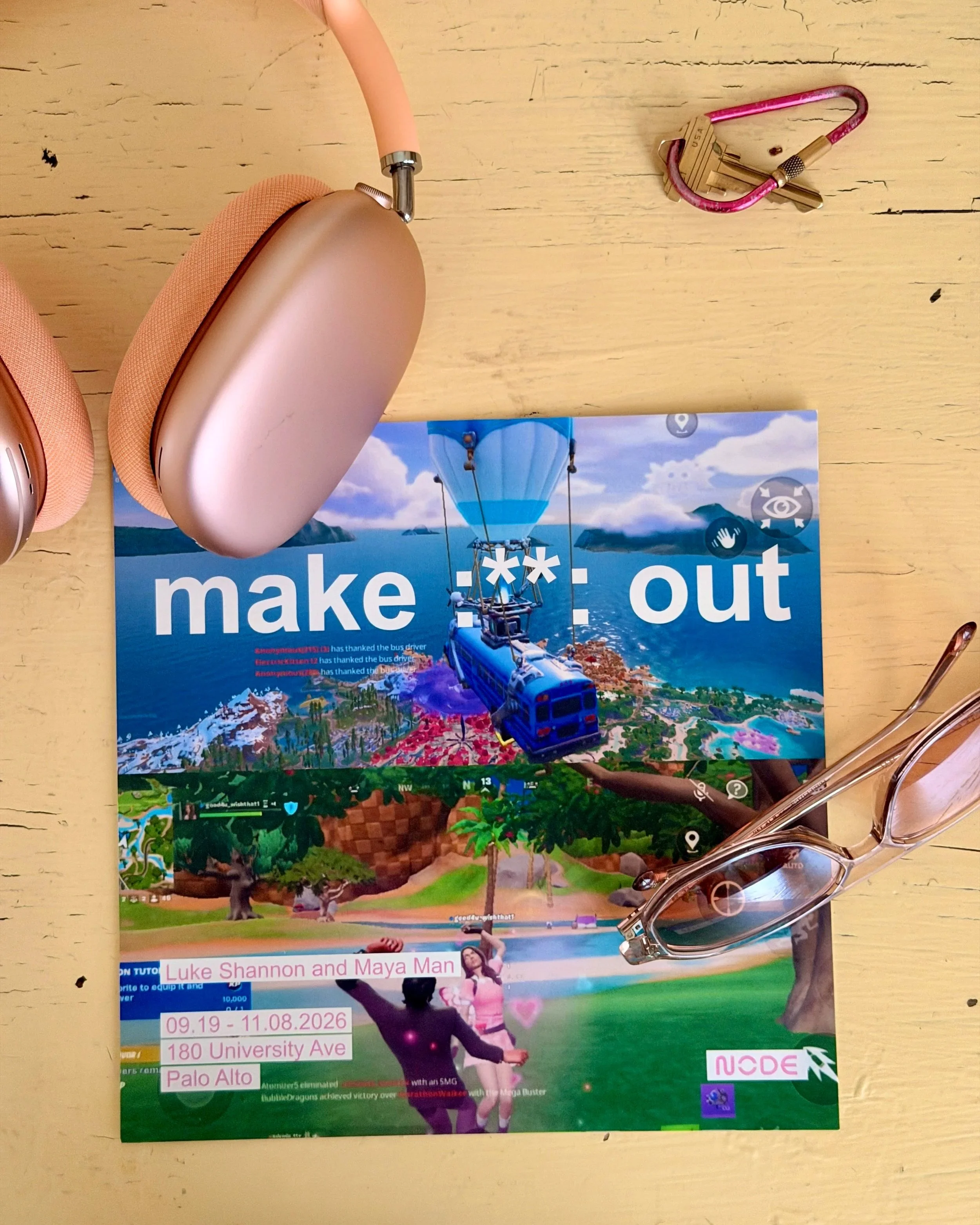
Within the semi-enclosed space, "the node," is a three-channel video created using Fortnite, titled Battle Royale Pas de Deux. As someone whose only installed game is Stardew Valley (I don’t even have mods, I know), a first-person shooter game sounds like an express train to overstimulation town. But I found myself sitting through the entire 16-minute work for a third (!!!) time, having gathered three strangers who likely joined out of curiosity after seeing me there for way too long.
Two people were a couple, likely in their late thirties, and the other was a familiar stranger I’ve seen at previous NODE openings, popping in for his third visit to the space.
As the game world closes in, Maya (as Olivia Rodrigo) and Luke (as John Wick) are forced into and trapped by the swirling purple storm, taking turns reviving each other when struck by lightning until the game ends with them in first and second place.
Colorful graphics, hilarious emotes, and over-the-top costumes. A 16 minute love story in Fortnite produced an out-of-body experience - maybe because I wasn't expecting to cry about anything related to Fortnite, or for a work to make me miss my husband, whom I've been away from for 24 hours.
“wait is this fucking play about us” - Read it and Weep, 2022
While Maya's work looks outward, Luke's portion of the show redirects the attention inward. The Plotter Scanner doesn't require, but encourages, active participation in the form of a performance for both the machine and other visitors. It was mesmerizing to watch. Unfortunately, I was far too self-conscious to lie on the Plotter Scanner for seven minutes as it conducted a close-range survey of me, my belongings, and my pose(s) of choice—all while friends and strangers watched. There’s so much to be said about the Plotter Scanner, but Maya et al. say it better than I ever could. (Read the essay collection at:https://drive.google.com/file/d/1HwYZhAbIFnkM3M-kJif4ljJvhZ-1a_qm/view!)
Just to the right of the Plotter Scanner are Health (For You), AI (For You), and Dating (For You). Each of the three screens displays a live camera feed of a resin-printed hand holding an iPhone. The mechanical thumb, with a rather unsettlingly wide range of motion, scrolls through reel after reel. The cameras are connected to a local AI model that examines the live feed and controls the scroll, training the Instagram algorithm toward three subjects: health, AI, and relationships. The hand's movement seems mechanical, and I can't help but predict how quickly the thumb will swipe away from content I deem irrelevant to the subject at hand. (bu dum tss)
The AI-controlled hands behave as we subconsciously do while consuming content: they stay on relevant reels for longer, and quickly scroll past the rest. As the visitor, watching and predicting the action of the machine, I found myself occupying the position of the algorithm, examining and labeling the content in my mind in order to predict whether it'll be of interest, and receiving feedback in the form of "stay" or "scroll."
People often talk about "The Algorithm" as if it's a mythical, unknowable, and unpredictable creature; perhaps it's because categorizing likes and dislikes feels simple, but only when it comes to ourselves. After seeing the robotic hand stay on yet another reel I would've deemed irrelevant to health, I was itching to scroll away from the lawnmowing video. I'd also like to think that the one dedicated to AI stayed on dog videos for a few hours must've sensed my preference over Bluetooth.
“Steve Madden buckle ballet flats- never worn!!”
“NEVER WORN, 100% NEW”
“BRAND NEW Salvatore Ferragamo Mimi 1cm Opera Nappa Calf” - (The Angels Wanna Wear My) Red Shoes, 2025
Luke's final work in the show, Attention Is All You Need, is illuminated by two ring lights, each encircling a hand holding an iPhone and a camera, facing each other. The endless scrolling and cameras are searching for identical videos that appear in both feeds. Seeing a reel from a friend and saying, "omg I just saw that earlier," feels common, but watching two mechanical hands try to replicate it feels like Mission: Impossible. Inches apart, the phones are so close, but algorithmically, they could be miles or millimeters apart. Maybe all it takes is just one more reel, and 30 more seconds of attention.
“We’ve become cheerfully indentured to the idea that our worth as individuals isn’t our personal integrity or sense of virtue, but our ability to advertise our relevance on the platforms of multinational tech corporations.” - Read it and Weep, 2022
Make:**: Out is for the generation that remembers the switch from a Motorola Razr to an iPhone, and it’s for everyone who’s used to being anonymous on the internet.
I began my exploration of the internet with nonsensical usernames that obscured my nationality, age, gender, and existing identity. Instead of fortifying relationships based on existing real-world friendships, I made friends on the internet through shared interests, celebrities, video games, TV shows, and memes, rather than the school I went to or the city I was from.
Finding your people through shared interests honed our ability to identify and connect with strangers using everything but demographic and personal information, and Make:**: Out captured that feeling of online chatrooms, anonymous viral Tumblr fandom pages, and friends whose faces we would never recognize.
Before I left to catch my flight, a new couple was watching Battle Royale Pas de Deux with their backs to each other, sitting on the same stool.
Make:**: Out is on view at NODE, Palo Alto, through November 8, 2026